
On March 13, 2026, the United States released economic data that shook financial markets and set the stage for a critical weekend for Bitcoin.
The fourth-quarter GDP for 2025 was revised down to 0.7%, significantly lower than the initial estimate of 1.4%, following 4.4% growth in Q3.
At the same time, January core PCE inflation rose 3.1% year-over-year, with a monthly increase of 0.4%.
Durable-goods orders were flat, core capital goods orders showed no growth, and real consumer spending edged up just 0.1%. These numbers reflect weaker consumer demand and slower business investment.
The data arrived after last year’s 43-day government shutdown and the US-Israel conflict with Iran, which spiked oil prices to $119.50 before easing back near $100.
Gasoline prices in the US have risen 20% to $3.58 per gallon since the conflict began (source�).
Bitcoin Holds Amid Oil Surge and Geopolitical Tension
Despite macroeconomic pressure, Bitcoin (BTC) has shown signs of stability.
The cryptocurrency traded around $70,600 as of press time, hitting an intraday high of $74,000 on March 13.
ETF inflows have returned since March 11 (Glassnode report�), spot demand is recovering, funding rates have turned negative (source�), and options volatility has eased.
From March 9–12, US spot Bitcoin ETFs recorded net inflows of $583 million, after a $348.9 million outflow on March 6 (Farside Investors�).
Why This Weekend Matters
Bitcoin faces a challenging macro backdrop: slower growth, sticky inflation, and a Federal Reserve with limited options.
Futures markets have scaled back expected 2026 rate cuts to just a quarter-point by December, down from two before the conflict.
The Fed meets March 17–18, and investors will closely watch for any guidance on interest rates.
Analysts say that if Bitcoin can maintain support above key levels, it could attempt a push toward $80,000. But a breakdown below support could trigger short-term selling pressure.
Economic Context Behind the Numbers
Q4 2025 GDP: 0.7% (down from 1.4% initial estimate) – shows slowing growth
Real final sales to private domestic purchasers: 1.9% – reflects weaker underlying demand
Core PCE inflation: 3.1% YoY – well above Fed’s 2% target
Real consumer spending: 0.1% MoM – very slow increase
Core capital goods orders: Flat, with shipments down 0.1% – weaker business investment
These figures already painted a concerning picture before the February energy shock caused by the Iran conflict.
Economists warn that rising energy prices could further worsen the trade-off between growth and inflation (Reuters report�).
Goldman Sachs analysts estimate that $100 oil could shave 0.4% off global growth while adding 0.7% to headline inflation globally (source�).
Conclusion
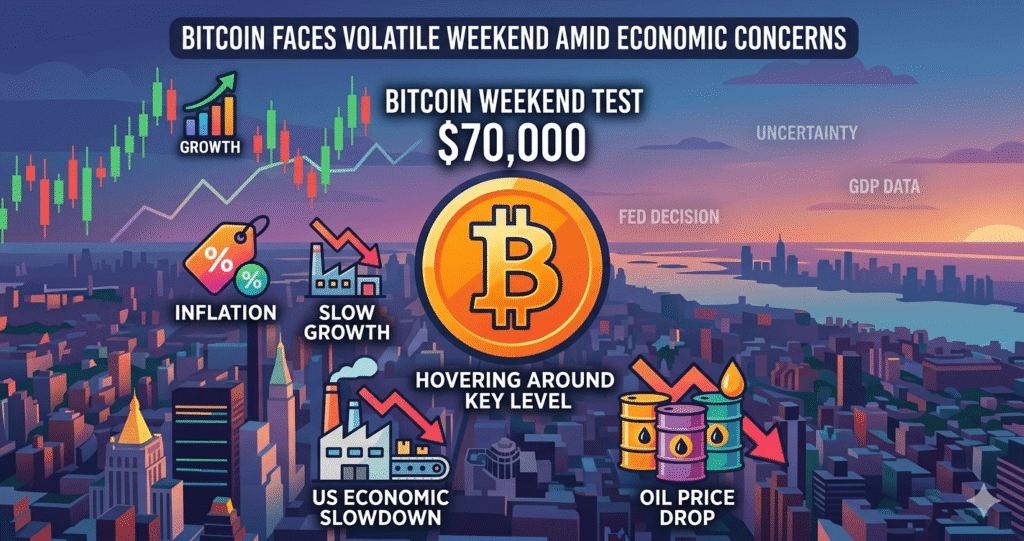
The combination of slowing US growth, persistent inflation, and geopolitical tensions makes this weekend a key test for Bitcoin.
Traders are watching whether BTC can hold support above $70,000, recover further, or face a short-term correction before the next Federal Reserve meeting.